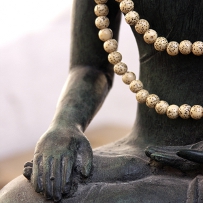
As a monk, I bring a strong commitment, along with the renunciate flavor, to the classic Buddhist teachings. I play with ideas, with humor and a current way of expressing the teachings, but I don't dilute them.
Sitting in a field of fifty to eighty people really starts my mind sparking. Since I don't prepare my talks ahead of time, I find myself listening to what I'm saying along with everyone else. This leaves a lot of room for the Dhamma to come up. Just having eighty people listening to me is enough to engage me, stimulate me, and create a nice flow of energy. The actual process of teaching evokes ideas that even I did not realize were being held somewhere in my mind.
Different teaching situations offer their own unique value. In retreat, you are able to build a cohesive and comprehensive body of the teachings. When people are not on retreat and come for one session, it opens a different window. They are more spontaneous and I'm given the chance to contact them in ways that are closer to their "daily-life mind." This brings up surprises and interesting opportunities for me to learn even more.
I'm continually struck by how important it is to establish a foundation of morality, commitment, and a sense of personal values for the Vipassana teachings to rest upon. Personal values have to be more than ideas. They have to actually work for us, to be genuinely felt in our lives. We can't bluff our way into insight. The investigative path is an intimate experience that empowers our individuality in a way that is not egocentric. Vipassana encourages transpersonal individuality rather than ego enhancement. It allow for a spacious authenticity to replace a defended personality.
I normally incorporate Qi Gong instruction in my retreats. They are not suitable as audio files but you can watch the nine videos here: https://tinyurl.com/Sucitto-qigong
Q1 Could you speak further on how we can preserve our energies? 04:46 Q2 I've a volatile and troubled sibling and have tried to act with compassion. But the cost is over dependency and the constant drama. What can you advise? 17:33 Q3 Is there a way in meditation to deal with blind spots? 24:09 Q4 How would you suggest that we work with traumatic life events that have occurred in the past and of which one has hardly any recollection of? 27:28 Q5 How to deal with persistent feelings in different parts of the body? 33:24 Q6 I had a lot of difficulty with my hand. Sometimes the pain would throw me to the floor. QiGong has been helpful. Can you suggest any other techniques? 37:17 Q7 I've had problems in my throat with difficulty to swallow and also feeling difficult to balance and an inner shakiness. Do you have any suggestions? 38:48 Q8 Some meditation instructions I've tried suggest progressing in stages and only moving on to the next set of challenges once mastery has been achieved in the current level. I often feel contracted with a sense of me, doing this type of practice. What would you advise? 43:07 Q9 Can you please give further clarifications on cetana. 48:35 Q10 The mind can be silent for a long period of time with a few thoughts coming and going. I'm not sure what I should do. Just observe? I can be bored sometimes.
Q1 Do you emphasize one form sitting, standing, walking, reclining over the others when meditating? Q2 08:30 the mind feels cooked during longer sitting meditations. Some heavy energy in my head develops into a headache. What do you suggest? 10:17 Q3 This person says they feel like something disgusting and worthless. 17:17 Q4 You talked about ghosts and how we can create them. Even if we stay sensitive and open whom can we meet other or connect to than our perceptions? 23:11 Q5 How is it possible to face the resistances to this practice and to participating in retreats? 33:56 Q6 I have imaginary conversations and dialogues with people and about imagined situations going in my head all the time. Especially when I sit down to meditate. a) What are they? b) What causes this habit? c) How do I set these aside?